
How to measure your head accurately for hat sizing

Getting your hat size right starts with one measurement: your head circumference. Grab a flexible tape measure, the kind used for sewing, and you're most of the way there. No tape measure? A piece of string and a ruler work just as well.
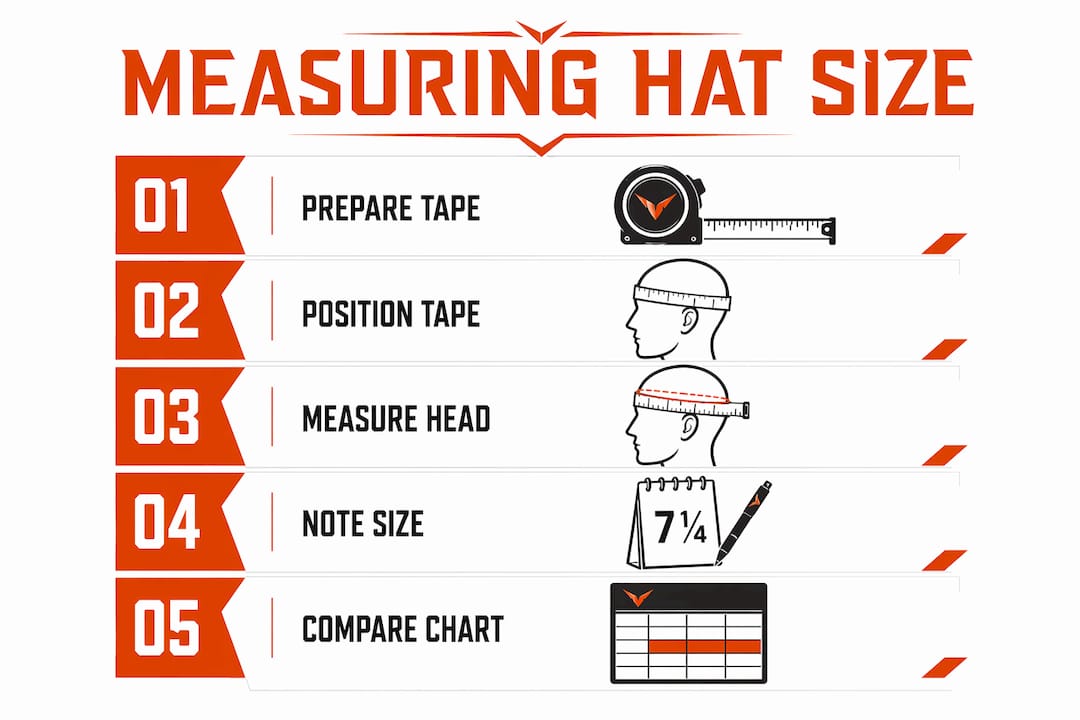
Here's how to do it:
- Wrap the tape measure around the widest part of your head, roughly one inch above your eyebrows and ears.
- Keep the tape parallel to the floor all the way around.
- Hold it snug against your head but not tight enough to indent your skin.
- Note the number where the tape overlaps, in both inches and centimeters.
- Measure twice for consistency before recording your final number.
Pro Tip: Ask a friend to hold the tape in place while you check the measurement. Even a slight angle can throw off your reading, and two sets of eyes catch that faster than one.
Table of Contents
- US hat sizing chart and how conversions work
- Tips for choosing the right hat size and getting the best fit
- Urban hat sizing and what it means for your style
- Hoeonline hats: urban style that actually fits
- Key Takeaways
US hat sizing chart and how conversions work
Once you have your head circumference, the next step is translating that number into a US hat size. The formula is straightforward: divide your head circumference in inches by π (3.14), and you get your US hat size. A circumference of 22.75 inches divided by 3.14 gives you roughly 7.25, which rounds to a size 7 1/4.

Most adults fall between US sizes 6 5/8 and 7 3/4. Men's heads average around 57–58 cm (US 7 1/8–7 1/4), while women's average slightly smaller at 55–56 cm (US 6 7/8–7). That said, adult hat sizing is unisex by construction. The physical size is the same regardless of gender; only the style and labeling differ.
The US hat size chart shows a progression of sizes from smaller to larger, with typical hat sizes ranging across an adult spectrum. Exact inch and centimeter conversions vary by manufacturer.
For UK sizing, the numbers correspond closely to US sizes. European sizes generally use metric measurements in centimeters. This makes the hat size conversion between systems simpler than most people expect.
Tips for choosing the right hat size and getting the best fit
Knowing your measurement is step one. Getting the right hat in your hands is a different challenge, and a few things can trip you up.
- Size up when you're between sizes. A hat that's slightly large is far easier to fix than one that's too tight. A foam strip or hat sizing tape inside the band takes up the slack in minutes. Stretching a tight hat is a much harder fix.
- Check the brand's own chart every time. Hat sizing varies significantly between manufacturers, and what one brand calls a Large another might label XL. Brand-specific sizing guides are the only reliable reference.
- Factor in crown height. A deeper crown adds volume and can feel roomier even at the same circumference. Shallow crowns sit closer to the head and require a more precise fit to stay stable.
- Fitted vs. adjustable hats need different approaches. Fitted caps require an exact size. Snapbacks, dad hats, and adjustable styles give you a range of about two sizes, so they're more forgiving if your measurement lands between numbers.
- Use hat sizing tape for fine-tuning. Foam or fabric inserts placed inside the sweatband narrow the fit without altering the hat's structure. This works especially well for vintage or one-size styles.
- Watch your tape tension. Pulling the tape too tight gives you a smaller reading than your actual head. Too loose and you'll order a hat that slides down to your eyebrows.
Urban hat sizing and what it means for your style
In urban fashion, a hat isn't just functional. It's part of the statement. Caps, snapbacks, and beanies carry as much weight as the rest of the outfit, and a hat that fits wrong throws off the whole look. Wearing a cap that sits too high or a beanie that bunches awkwardly at the crown undercuts the confidence the look is supposed to project.
Hoeonline builds its headwear around exactly this idea. The brand's caps and snapbacks are designed for people who treat their wardrobe as an extension of who they are, not just what they wear. Precise sizing isn't a technical detail here; it's what makes the difference between a hat that looks intentional and one that looks borrowed. When you know your measurement and understand how fitted versus adjustable styles behave, you can shop with confidence instead of guessing.
Hoeonline hats: urban style that actually fits
Hoeonline carries caps, snapbacks, and beanies built for people who take their look seriously. Every piece reflects the brand's H.O.E. (Happiness Over Everything) ethos: bold, urban, and made to be worn with intention. Whether you're after a fitted cap that locks in at your exact size or an adjustable snapback with room to dial in the fit, the range covers both.
Now that you know your head circumference and how to read a sizing chart, putting that knowledge to work is straightforward. Browse the full headwear collection at Hoeonline and find the style that fits your size and your vibe.
Key Takeaways
Measuring your head circumference accurately and cross-referencing a US hat sizing chart is the fastest path to a hat that fits and looks right.
| Point | Details |
|---|---|
| Measure at the widest point | Wrap tape one inch above eyebrows and ears; record in both inches and centimeters. |
| US size formula | Divide head circumference in inches by 3.14 to get your US fractional hat size. |
| Most adults: sizes 6 5/8–7 3/4 | Men average 57–58 cm (US 7 1/8–7 1/4); women average 55–56 cm (US 6 7/8–7). |
| Size up when between sizes | Foam inserts fix a slightly large hat; a tight hat has no easy fix. |
| Hoeonline headwear | Caps, snapbacks, and beanies sized for urban fashion with both fitted and adjustable options. |