What does a standard t-shirt size chart actually tell you?
A t-shirt size chart maps garment dimensions to body measurements so you can order the right size without trying anything on. The key distinction to understand first: garment measurements are taken with the shirt laid flat, while body measurements are circumferences. Garment chest width doubled approximates your body chest circumference, so a shirt measuring 20 inches across the chest fits a roughly 40-inch chest.
Standard sizing adds ease allowance, typically 2–4 inches of extra room, so the shirt moves with you. Regular fit adds about 1–2 inches of garment width over a snug fit; athletic fit subtracts roughly an inch; oversized adds 3–6 inches over regular at the same size label.
Standard Unisex T-Shirt Size Chart (Men's/Unisex)
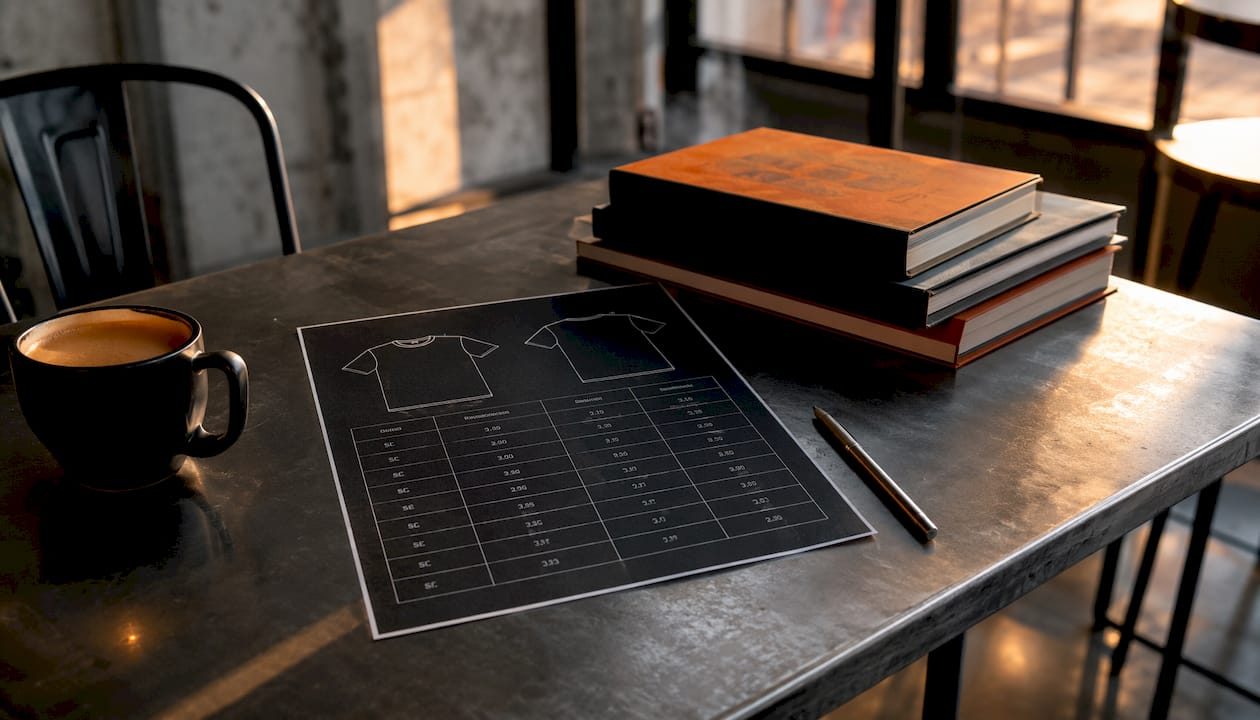
| Size | Chest Width (flat, in) | Full Chest (in) | Body Length (in) | Sleeve Length (in) |
|---|---|---|---|---|
| M | 20 | 40 | — | — |
| L | 22 | 44 | — | — |
| XL | 24 | 48 | — | — |
| 2XL | 26 | 52 | — | — |
| 3XL | 28 | 56 | — | — |
Each size step adds approximately 2 inches in chest width and 1 inch in body length. Tall sizes typically add 2 inches to body length without changing chest width. Brand sizing varies, so always check the specific brand's chart before ordering.
Table of Contents
- How to measure your t-shirt size accurately
- How men's, women's, youth, and unisex sizing differ
- How fabric weight changes the way your shirt fits
- Hoeonline has the sizes and styles to match your measurements
- Key Takeaways
How to measure your t-shirt size accurately
The most reliable method is measuring a shirt you already own and love the fit of. Lay it flat, smooth out any wrinkles, and measure pit to pit for chest width, then compare that number to a size chart. This beats guessing from a label every time.
Step-by-step measurement guide:
- Chest width (garment): Lay the shirt flat. Measure straight across 1 inch below the armhole seam, from one side to the other. Double this number for full chest circumference.
- Chest circumference (body): Wrap a flexible tape measure around the fullest part of your chest, just under your arms. Keep it level and snug but not tight.
- Body length: Measure from the highest point of the shoulder near the neckline straight down to the bottom hem.
- Sleeve length: Measure from the shoulder seam to the end of the sleeve along the top of the arm.
- Shoulder width: Measure from shoulder seam to shoulder seam across the back, just below the collar. This is one of the most telling measurements for fit.
Common pitfalls to avoid:
- Using a rigid ruler instead of a flexible tape
- Measuring over thick clothing
- Pulling the tape too tight around the chest
- Ignoring shoulder width and focusing only on chest size
Pro Tip: If you're between sizes, size up. A slightly larger shirt is comfortable; a too-small shirt is unwearable and won't get better after washing.
Shoulder alignment is the single most important fit point. The shoulder seam should land right at the bony corner where your shoulder ends and your arm begins. If it droops down your arm, the shirt is too big. If it pulls toward your neck, go up a size.
How men's, women's, youth, and unisex sizing differ
Understanding sizing categories saves you from ordering the wrong cut entirely, not just the wrong number.
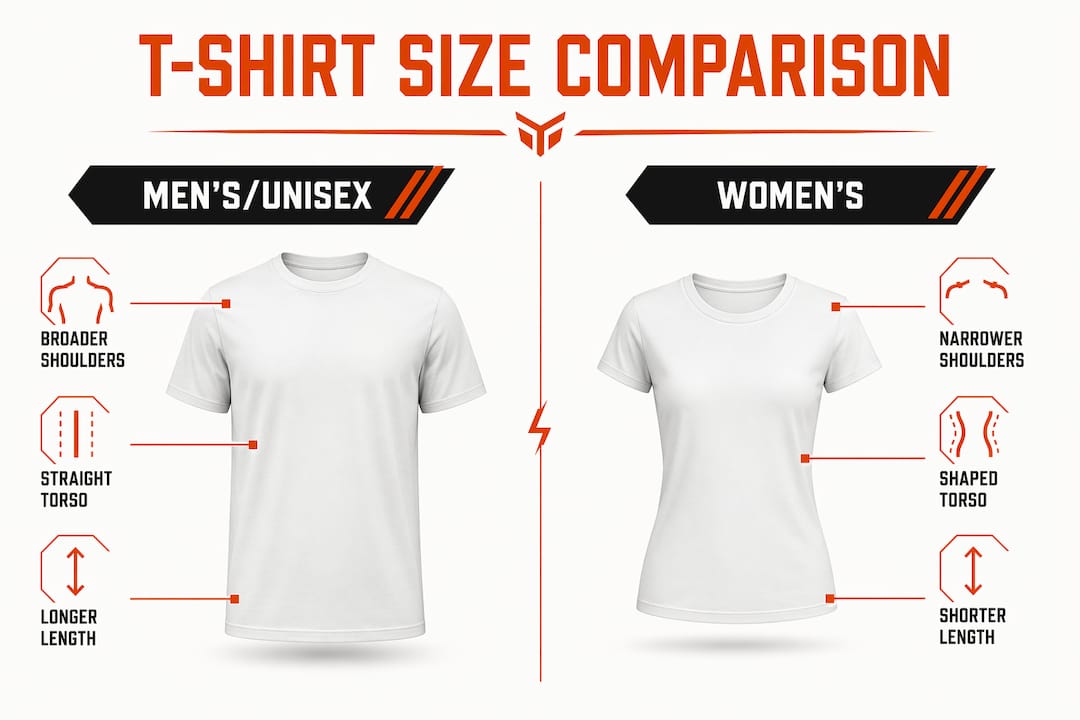
Men's and unisex sizing share the same construction: broader shoulders, straight torso, longer body length. Unisex sizing is built on men's proportions, which means the shoulder width and chest are cut wider and boxier than women's styles.

Women's sizing runs smaller in the body with shorter sleeves and a more shaped torso. Women's tees taper at the waist and are cut for a narrower shoulder. If a woman orders a unisex tee, sizing down 1–2 sizes usually gives a better fit because unisex garments have broader shoulders and boxier torsos.
Youth sizing is its own system entirely. Youth XL is proportioned differently from adult small, with a shorter body length and wider width relative to height. Teens transitioning from youth to adult sizing often fit better in an adult small for proportional length, even if the chest measurement seems close.
Pro Tip: For teenagers, compare the youth L measurements directly against adult S measurements on the brand's chart. Adult sizing often works better for taller teens even when the chest numbers look similar.
Fit type differences at the same size label:
- Slim fit: Chest width narrows by 1–2 inches, tapers through the torso
- Regular/standard fit: Straight cut, moderate ease, works for most body types
- Athletic fit: Wider through chest and shoulders, tapers toward the waist
- Oversized/relaxed fit: Adds 3–6 inches over regular, often features drop shoulders
The biggest mistake people make is ordering based on a size label without checking measurements. An XL in one brand can measure the same as an L in another.
How fabric weight changes the way your shirt fits
Fabric weight, measured in GSM (grams per square meter), affects how a shirt drapes, moves, and holds its shape. Two shirts in the same size can feel completely different depending on their weight.
Fabric weight categories and their fit characteristics:
- Lightweight (under 150 GSM): Thin, soft, drapes loosely. Can cling to the body in warm weather. Good for layering or summer wear, but less structured.
- Mid-weight (180–220 GSM): The standard for everyday t-shirts. Holds its shape, skims the body without clinging, and works across fit types. Mid-weight fabrics with relaxed or oversized cuts are the go-to combination in urban streetwear.
- Heavyweight (220+ GSM): Thick and structured. Creates a boxy, substantial silhouette. Popular for oversized styles, but can feel stiff and restrict movement if sized too small.
Lightweight fabrics under 150 GSM cling loosely, mid-weight at 180–220 GSM provides balanced structure, and heavyweight at 350–420 GSM can become bulky and lose shape if the fit isn't accounted for.
One thing worth knowing: oversized and boxy tees often feature drop shoulders, where the shoulder seam sits 1–2 inches lower than on a standard tee. This changes how sleeve length reads. The sleeve may look shorter than expected because the reference point has shifted down the arm. It's a deliberate design choice, not a sizing error.
For urban-inspired styles, mid-weight fabric in a relaxed or oversized cut gives you structure without stiffness. The shirt holds its shape through the day without clinging or going shapeless.
Hoeonline has the sizes and styles to match your measurements
Once you know your measurements, the next step is finding clothes actually worth wearing. Hoeonline builds every piece around urban style and real comfort, from unisex hoodies and tees to joggers, crop hoodies, and accessories, all available in multiple colors and fits for men and women.
The sizing at Hoeonline follows the unisex conventions covered in this guide, so the measurements you just took translate directly. Whether you're after a relaxed streetwear fit or something closer to the body, the range covers both. Every piece is designed to express something, not just cover you.
Check out the full collection at Hoeonline and use your measurements to pick with confidence.
Key Takeaways
Accurate garment measurements, not size labels alone, are the most reliable way to find a t-shirt that fits correctly when buying online.
| Point | Details |
|---|---|
| Garment vs. body measurement | Chest width laid flat, doubled, gives your full body chest circumference for size matching. |
| Size steps are consistent | Each size up adds approximately 2 inches in chest width and 1 inch in body length. |
| Unisex sizing runs larger | Women shopping unisex should size down 1–2 sizes due to broader shoulders and boxier cuts. |
| Fabric weight shapes the fit | Mid-weight (180–220 GSM) gives structure; lightweight clings; heavyweight adds bulk. |
| Hoeonline for urban fits | Hoeonline offers unisex tees, hoodies, and more sized to these conventions for confident online ordering. |